
No, lifting weights will not make you bulky. A 2020 review of 24 randomized trials in women found an average muscle gain of about 3 pounds over roughly four months. Over that same stretch, strength rose by about 25%.
- Trials in women found about 3 pounds of muscle gained over roughly 15 weeks of full-body lifting.
- Strength rose about 25% in that same window, roughly eight times faster than muscle size.
- Supervised training produced bigger lower-body strength gains than training alone.
- In one 8-month trial, supervised high-intensity training raised spine bone density 2.9% in postmenopausal women.
- Only 23.8% of US women ages 45 to 64 meet the CDC muscle-strengthening guideline, so the real risk is never starting.
That contrast is the honest answer to the bulky question. You get noticeably stronger long before you look any bigger. For women in their 40s, 50s, and 60s, that trade is exactly the point.
Below is what the trials actually measured, what real size would take, and what you get instead. If you'd like the wider picture first, start with our guide to strength training for women over 40.
What do women actually gain from lifting weights?
Women who lift gain a lot of strength and a modest amount of muscle. The clearest numbers come from a 2020 review in Sports Medicine. Researchers pooled 24 randomized trials that included 912 women.
The programs were full-body strength plans lasting about 15 weeks on average. Lean mass rose 3.3%. That worked out to about 1.45 kilograms, or roughly 3.2 pounds.
The range matters too. Across the trials, gains ran from about 1 pound at the low end to about 7 pounds at the top. No program in the review produced more than that.
Strength told a very different story. Upper-body strength rose about 25% on average. Lower-body strength rose about 27%. In some trials, lower-body strength gains reached as high as 54%.
Here's one honest caveat. The women in these trials ranged from 18 to 50, with an average age around 27. So treat the numbers as a picture of what lifting does for women, not a promise for any one body. Still, the pattern is clear and consistent.
It also lines up with what most people want from training after 40. You want to carry, climb, lift, and move without thinking twice. Those are strength goals first. The research suggests that's exactly where the biggest changes land.
Strength grows about eight times faster than size
In that review, strength climbed roughly eight times faster than muscle size. Lean mass rose 3.3%, while strength rose about 25% to 27%.
In everyday life, that gap shows up as capability. Carrying shopping bags back to the car at Southdale Center starts to feel easier. Getting up off the floor takes less effort. Lifting a carry-on into an overhead bin stops being a negotiation.
Meanwhile, your clothes fit about the same. Three pounds of new muscle, spread across a full-body program, is hard to spot in a mirror. The trials measured a big change in what women could lift and a small change in size.
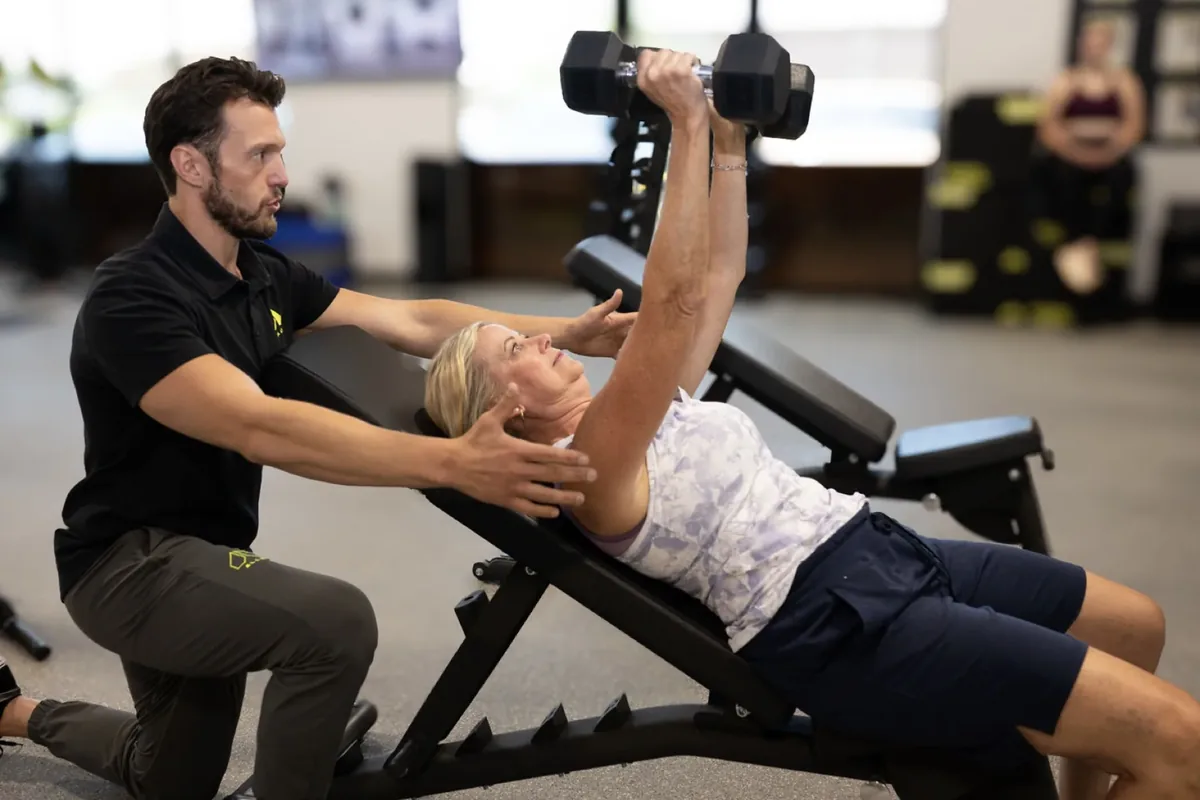
How you train matters as well. The same review found supervised training produced larger lower-body strength gains than training alone. Having someone watch your form and adjust your loads appears to pay off.
That's one reason coached formats like small group personal training exist. You get a program written for you, plus a coach in the room who keeps the work honest. For many women, that structure is what turns a good intention into a steady habit.
What would it actually take to get visibly big?
Getting visibly big takes years of deliberate effort, and it rarely happens by accident. Women who look truly muscular built that size on purpose. They trained with high volume for a long time and ate deliberately to support growth.
That's a very different project from a few coached sessions a week. Look again at the trial range. Even the strongest result in the review topped out around 7 pounds of lean mass. Those were dedicated, structured programs, not casual workouts.
Size also doesn't sneak up on you. At roughly 3 pounds over four months, you'd see any change coming well ahead of time. If you ever wanted less of it, you could simply change your training. You stay in control of that dial the whole way.
A sensible start looks nothing like a bodybuilding plan. You learn a handful of basic movements: squats, hinges, pushes, pulls, and carries. Loads go up gradually as your form holds. Progress gets tracked, so nothing changes by surprise.
So if bulk is the worry, it helps to name what's really on the table. A few pounds of muscle. A lot more strength. Far fewer reasons to avoid the weight room.
"Toned" usually means more muscle and less fat
The look most women call "toned" is mostly a little more muscle and a little less fat. Lifting helps on both sides of that equation, even without a diet change.
A 2022 meta-analysis of 58 studies looked at resistance training alone, with no diet changes, for at least four weeks. Body fat percentage dropped by about 1.5 points on average. Fat mass fell by about 0.55 kilograms, a little over a pound. Visceral fat, the deeper fat around the organs, went down too. Results did not differ between men and women.
Those are modest numbers, and we want to be clear about that. This is recomposition, not rapid weight loss. Your scale might barely move while your body changes underneath it.
That's also where the bulky fear misreads the goal. A bit more muscle paired with a bit less fat tends to look leaner, not larger, at the same body weight. If you're weighing lifting against mat workouts for that look, our comparison of Pilates vs. strength training for women over 40 walks through it.
A bathroom scale can't show recomposition. A body composition scan can track muscle and fat separately, and rescanning monthly lets you watch the trend. Here's how to read InBody results if you're curious what those numbers mean.
Heavy, supervised lifting also showed bone benefits
Bone is one more reason lifting matters after 40, and one trial makes the point well. The LIFTMOR trial followed 101 postmenopausal women with low bone mass for 8 months.
One group did twice-weekly, 30-minute sessions of supervised high-intensity resistance and impact training. Their lumbar spine bone density rose 2.9%. The low-intensity comparison group lost 1.2% over the same period.
That result matters because women in midlife are often steered toward the lightest options in the gym. This trial tested something more demanding, in women who already had low bone mass. The harder, supervised program came out ahead on spine density.
Two details matter here. Every session was supervised, and the training was genuinely challenging, not light toning work. We won't promise anyone a bone result from those numbers. For the full picture, read our guide to strength training and bone density for women over 50.
The real risk is never starting
The bigger danger for women isn't bulking up. It's never picking up a weight at all. CDC survey data from 2020 show only 26.9% of US women met the muscle-strengthening guideline. For men, the figure was 35.2%.
The gap widens with age. Among women ages 45 to 64, just 23.8% met the guideline. For women 65 and older, it dropped to 17.2%.
Edina is full of active people. You see them on the walking paths at Centennial Lakes Park and along the Edina Promenade. Walking is a great habit, and we'd never talk anyone out of it. But walking on its own isn't muscle-strengthening work.
Starting doesn't require a big leap. The LIFTMOR sessions, for example, lasted just 30 minutes, twice a week. Short, focused, and coached is a realistic way to begin.
So here's our stance. If the bulky myth is what's keeping you off the weights, let it go. A few pounds of muscle is the realistic upside of a careful start, not the downside. The strength, the leaner composition, and the bone research are what's actually on offer.
Start with one session
Alloy Personal Training Edina, at 6805 B York Ave S by Cub Foods Southdale, starts every membership with a free Starting Point Session. You'll cover your health history and goals, get an InBody body composition scan, and complete a functional movement assessment and an introductory workout. Book your Starting Point Session and see where your strength stands today.
Have a health condition, injury, or bone density concern? Talk with your doctor before starting a new strength program.
Frequently asked questions
Will lifting weights make my arms bigger?
Not in any way most people would notice. Trials in women found about 3 pounds of muscle gained across the whole body over roughly four months. Strength, on the other hand, rose about 25% in the upper body. What changes most is what your arms can do.
Can lifting weights help me lose weight?
It helps with body composition more than with the number on the scale. A 2022 meta-analysis found resistance training alone cut body fat percentage by about 1.5 points, with no diet change. Pair that with a little added muscle, and your weight may barely move while your shape shifts.
How often do women over 40 need to lift?
Consistency matters more than marathon sessions. The LIFTMOR trial in postmenopausal women used two 30-minute supervised sessions a week. That's a realistic starting rhythm for most busy schedules. Your doctor and coach can help you set the right pace for your health history.
Do I need a coach, or can I lift on my own?
You can lift on your own, but the evidence favors coaching. A 2020 review of trials in women found supervised training produced larger lower-body strength gains than training alone. A coach also handles form, loading, and progression, so you're not guessing.