
Yes, most adults with a history of low back pain can strength train, and major guidelines recommend exercise, not rest, for chronic back pain. The American College of Physicians' 2017 guideline puts exercise first on its list of nonpharmacologic options. A 2020 analysis of 89 studies ranked resistance training among the top exercise types for physical function, with Pilates first for pain. What changes is how strength training for back pain starts: red-flag symptoms go to a clinician, and everyone else gets a movement assessment before any load.
- Guidelines from the American College of Physicians (2017) and the VA and Defense Department (2022) support exercise, not rest, for low back pain.
- Red-flag symptoms, like loss of bladder control or unexplained weight loss, go to a clinician before any training.
- In a 2020 analysis of 89 studies, Pilates ranked highest for pain and resistance training among the highest for function.
- Loaded and unloaded exercise performed similarly on pain in a 2025 review, so heavy weights are a choice, not a rule.
- Back pain often returns (69% within a year in one 2019 study), so the goal is managing it over years.
Back pain after 40 is common, not a verdict
If your back acts up, you have plenty of company. In the 2019 National Health Interview Survey, 44.3% of US adults aged 45 to 64 reported back pain in the previous three months. The figure was 45.6% at 65 and older, compared with 28.4% among adults aged 18 to 29.
It also tends to come back. A 2019 study followed 250 adults who had recovered from an episode within the past month. Within 12 months, 69% had a recurrence, and 40% had one that limited their activity. Having more than two previous episodes and sitting more than five hours a day both predicted a return.
A 2016 meta-analysis in JAMA Internal Medicine, covering 21 trials and 30,850 people, linked exercise combined with education to fewer episodes. Education alone, back belts, and shoe insoles showed no clear benefit. No program in the research eliminated episodes entirely.
That's why we talk about managing a back over years. There's no six-week version. It's also why our approach to strength training after 40 is built on consistency, not short blocks.
What the guidelines say about exercise and rest
The major guidelines agree on the starting point, and it isn't bed rest. The American College of Physicians' 2017 guideline recommends beginning chronic low back pain care with nonpharmacologic options, and exercise is first on its list. It also notes that most people with a new or recent episode improve over time, regardless of treatment.
The 2022 guideline from the Department of Veterans Affairs and Department of Defense suggests a structured, clinician-directed exercise program. Its examples include strengthening exercises, Pilates, motor control work, aerobic exercise, tai chi, and a structured walking program. It rates that suggestion as weak, and it lists advice to remain active for new and longer-lasting back pain alike.
Walking counts, and it doesn't have to wait for spring. The 15-mile paved Nine Mile Creek Regional Trail through Edina is plowed during the winter months.
A 2021 Cochrane review of 249 trials compared exercise with no treatment, usual care, or placebo. Exercise reduced chronic low back pain by about 15 points on a 100-point scale, which the authors called a clinically important difference. The effect on day-to-day function was smaller and fell short of that bar.
The 2018 Lancet series on low back pain is blunter about rest. It reports that guidelines put education, a return to normal activities, and exercise first, and it names rest among the responses used too often. A 2010 Cochrane review found stay-active advice beat bed rest slightly on pain and function after a new episode. A 2014 review of 21 studies found that fear of movement in the weeks after an episode predicted slower recovery.
The symptoms that go to a clinician first
Some back pain isn't a training question at all. The 2022 VA/DoD guideline lists red flags for possible serious conditions, grouped by what they may point to. These go to a clinician first, before any training program:
- Possible cauda equina syndrome (serious nerve compression): trouble emptying your bladder, loss of bladder or bowel control, or saddle numbness. Also changes in rectal tone, or severe or worsening leg weakness or numbness.
- Possible infection: fever, a weakened immune system, IV drug use, a recent infection, or an indwelling catheter.
- Possible fracture: a history of osteoporosis, long-term corticosteroid use, age 75 or older, recent trauma, or stress-fracture risk in younger people.
- Possible cancer: a history of cancer with new low back pain, unexplained weight loss, back pain that hasn't improved after a month, age over 50, or several risk factors at once.
Age appears on the list twice. If you're over 50 and anything else here sounds familiar, that is a physician conversation first.
None of these is a coaching call. Talk with your physician or physical therapist, and bring their guidance to your first session. We're glad to coordinate with them directly.
Which exercise ranks highest depends on the outcome
A 2020 network meta-analysis in the British Journal of Sports Medicine pooled 89 studies and 5,578 adults with chronic, non-specific low back pain. It ranked exercise types separately for each outcome, and no single type won everything.
| Exercise type | Outcome it ranked highest for | Ranking score (SUCRA) | Effect vs. true control (SMD, 95% CI) |
|---|---|---|---|
| Pilates | Pain | 100% | -1.86 (-2.54 to -1.19) |
| Resistance training | Physical function | 80% | -1.14 (-1.71 to -0.56) |
| Stabilization / motor control | Physical function | 80% | -1.13 (-1.53 to -0.74) |
| Resistance training | Mental health | 80% | -1.26 (-2.10 to -0.41) |
| Aerobic exercise | Mental health | 80% | -1.18 (-2.20 to -0.15) |
The ranking score runs from 0% to 100%, and higher means a type was more likely to be best for that outcome. The effect size is standardized, so the further from zero, the larger the effect. The true control groups, which got no exercise program, ranked 10% or lower on every outcome.
Read the table with two cautions. The authors described the evidence as low quality. And Pilates ranked first for pain, not resistance training, which earned its place on function and mental health.
Physical function means the everyday stuff: carrying groceries, climbing stairs, getting up off the floor. A program can mix strength work, trunk control, and walking in the same week.
Strength training for back pain: what the trials found
The trials on strength training for lower back pain are small, but none supports the old advice to avoid weights.
A 2015 trial put 30 adults with chronic low back pain, averaging about 40 years old, on a coached free-weight program. They trained three times a week for 16 weeks, and 26 finished. Reported pain fell 72% and disability scores fell 76%. The study had no control group, so it can't show the training caused those changes.
A 2015 Swedish trial of 70 adults with recurring low back pain compared deadlift training with low-load motor control exercise. Both groups had 12 sessions over 8 weeks. Pain improved about the same in each, while the low-load group gained more on activity scores, 4.2 points against 2.5.
A follow-up analysis looked at who did well among the 35 people in the deadlift group. The ones who benefited started with less pain, less disability, and better back-extensor endurance. Endurance was the most consistent predictor. The deadlift is a destination for some backs, not the first step for all of them.
A 2025 review of 13 trials and 778 adults found loaded resistance training safe and feasible for low back pain. Its effects on pain were similar to unloaded exercise. Heavy weights aren't required, and they aren't off-limits. Load is a tool your coach picks to match where your back is today.
How we program around a bad back
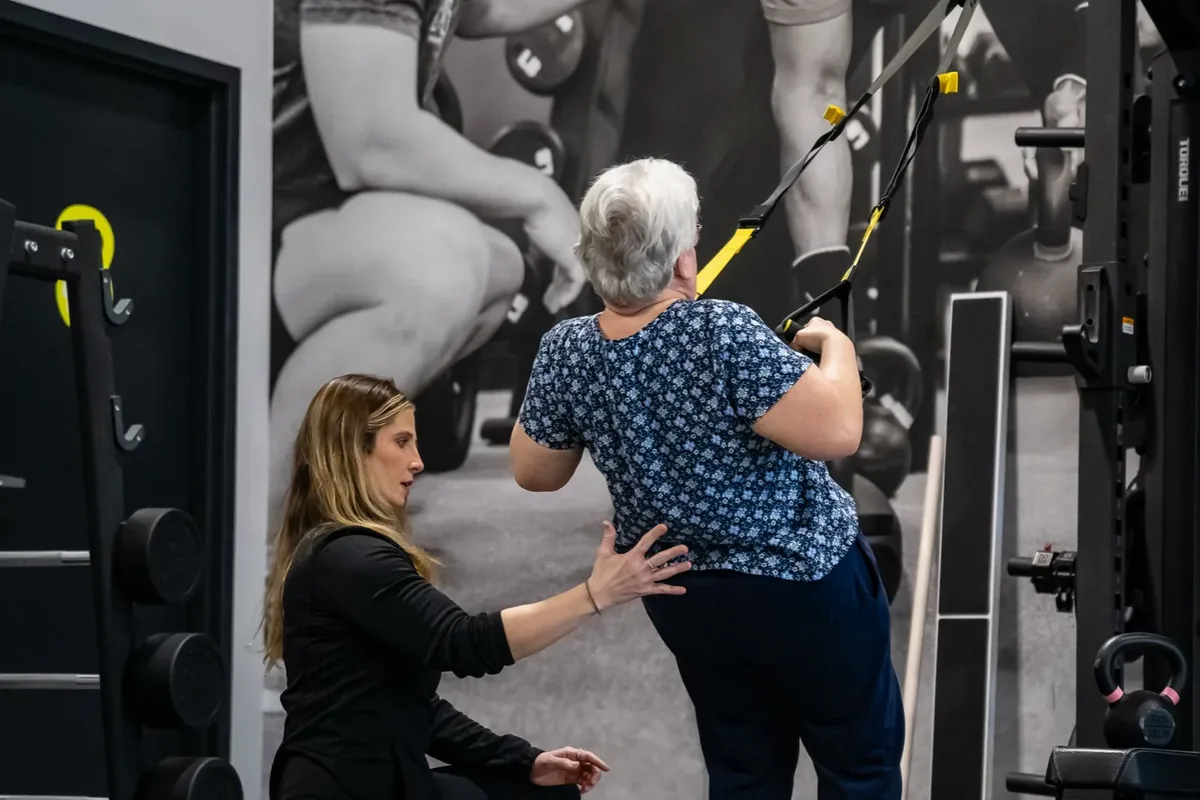
What follows is coaching practice, not a research finding. Every program starts with an assessment, not a barbell. At your Starting Point Session, a coach runs a functional movement screen, seven short tests of how you move. Any test that causes pain scores a 0, and that pattern stays out of your program until a clinician weighs in.
Next comes the hip hinge, the pattern behind every deadlift and every shovelful of snow. Coaches teach it with a wooden dowel held along your spine, touching your head, upper back, and tailbone. The Twin Cities' normal snowfall is 51.2 inches a year for 1991 to 2020, according to the Minnesota DNR. The driveway doesn't wait for your back to feel ready.
Load climbs in steps. A typical path has four: a bodyweight hinge, a kettlebell deadlift from raised blocks, the same lift from the floor, then a trap-bar deadlift. Nobody moves up a step because the calendar says so, and stopping at the kettlebell is a perfectly good outcome.
Coaches also adjust range and speed. A shorter range, like pulling from blocks or squatting to a box, keeps you out of positions that hurt. A slower tempo, such as three seconds on the way down, gives you and your coach time to see each rep. If your physical therapist has ruled out loaded forward bending, it stays out of your program.
Every weight, set, and rep is tracked, so load goes up on a record rather than a good day. If a movement brings on pain, the coach swaps in an easier version that session. Pain that lingers or worsens goes back to your clinician.
This is where a cap of six people earns its keep. Sessions run about 55 minutes, coach-led start to finish, and two people side by side are often doing entirely different work. One might pull a trap-bar deadlift while the next person hinges with a dowel. That's the point of small group personal training: the program is yours even when the room isn't.
For the bigger picture past 50, our guide to strength training after 50 covers what works and what to skip.
Start with how you move today
Alloy Personal Training Edina Southdale opened in October 2026 on York Avenue, minutes from Southdale Center. Your first step is a no-pressure Starting Point Session. A coach assesses how you move, talks through your back's history and your goals, runs an InBody scan, and builds a plan around you. Bring any notes from your physician or physical therapist. Book your Starting Point Session, and ask about Founding Membership if you'd like first pick of session times.
This article is general fitness information, not medical advice. Talk with your physician before starting a new exercise program, especially if you have a diagnosis, a recent surgery, or activity restrictions.
Frequently asked questions
Can you lift weights with lower back pain?
For most adults with chronic low back pain, yes, and guidelines recommend exercise as an early step. The American College of Physicians' 2017 guideline lists exercise first among nonpharmacologic options, and the 2022 VA/DoD guideline suggests structured exercise that includes strengthening. Red-flag symptoms, such as loss of bladder control or unexplained weight loss, go to a clinician first.
Is deadlifting bad for your back?
The trials so far don't show that, but it isn't the right starting point for everyone. In a 2015 trial of 70 adults with recurring low back pain, eight weeks of deadlift training improved pain as much as low-load control exercise. A follow-up analysis found it suited people with less pain and better back-extensor endurance. That's why the deadlift comes after the hinge is solid, not first.
Should I rest my back or keep moving?
Research favors staying active over bed rest. A Cochrane review found people advised to stay active did slightly better on pain and function than those told to rest in bed. The 2022 VA/DoD guideline also lists advice to remain active.
Will my back pain come back even if I strength train?
It may, since recurrence is common. In a 2019 study of 250 adults who had recently recovered, 69% had a recurrence within 12 months. A 2016 meta-analysis of 21 trials linked exercise to fewer episodes, especially when paired with education, but no program in the research eliminated them.