
What the medication does to muscle, and what two or three days a week of small group personal training in Edina does about it.
Almost everyone who tells me they're on a GLP-1 tells me quietly. Voice down, eyes somewhere else, phrased like a confession instead of a fact.
I'd like to skip that part. By the end of last year, roughly one in eight American adults said they were taking one of these medications, for weight or diabetes or something else. It's a normal thing now. It's also not the interesting part of the conversation. The interesting part is what happens to your muscle while the scale is moving, and what you do about it, because that's the piece a studio can actually help with. The rest belongs to you and your doctor.
What the scale doesn't separate
Anyone who loses weight loses some muscle along with the fat. That isn't a GLP-1 problem. That's a weight loss problem, and it was true long before anybody had a pen in the refrigerator door.
The difference is the proportion. In older behavioral weight loss research, lean body mass has accounted for somewhere in the range of 6 to 26 percent of what people lost. With GLP-1 therapy, published estimates have run higher, roughly 20 to 50 percent. That's a wide range and the research is still moving, so hold it loosely. But the direction has been consistent enough that it's worth planning around instead of finding out about later.
You can also just measure it instead of wondering. We run free InBody scans at the studio, membership or not, and a baseline scan before or early in treatment is the cleanest way to see which kind of weight is leaving.
Muscle is not vanity tissue. It's what gets you off the floor, off the couch, up out of the kayak without the grunt. Reduced muscle mass has been linked to lower bone density, worse balance, more fatigue, and a higher risk of a fall doing something ordinary. Losing a real chunk of it in your fifties, on top of what age is already quietly taking, is a bad trade even when the number on the scale is a good one.

The part about stopping
Most people don't stay on these medications indefinitely. In one large real-world analysis of US adults, more than 70 percent had stopped within two years. And in trial data, people who came off regained roughly two thirds of the weight they'd lost within the following year.
I'm not putting that here to talk anyone out of anything. Whether you stay on, come off, or change medications is a conversation with the person who prescribed it, and I have no business in it.
I'm putting it here because it changes what the training is for.
If there's a reasonable chance you're off the drug in two years, then the thing worth building right now is the thing that stays. Strength outlasts a prescription. So does knowing how to walk into a studio and load a machine without a twenty minute negotiation with yourself first. The medication is doing something time-limited and impressive. The strength is the part you keep.
How much, actually
A multinational white paper from the Health & Fitness Association modeled something very specific when it used the phrase "structured exercise": resistance training four days a week, plus 150 minutes of moderate aerobic activity, or 75 minutes of vigorous.
That's a research protocol. It's not what we ask of anyone here, and I'd rather say so plainly than let you go look at your calendar and quietly decide this isn't for you.
What we prescribe here is two to three sessions a week, full body, every time. Not a chest day. Not a leg day. Every session works everything, because push, pull, hinge, squat, and carry are what a body over fifty needs to keep, and skipping one for a week is how a weak link becomes an injury.
The math is less of a compromise than it looks. In a four-day split, any given muscle group might get trained once or twice in a week. In three full body sessions, everything gets trained three times. The weekly exposure per muscle ends up in a similar place, on a schedule a person with a job and a driveway to shovel can actually hold onto.
Two days done for a year beats four days done for six weeks. I have watched a lot of six-week versions. They almost always start in January.
Aerobic work is separate and it doesn't have to happen here. Walk. The Centennial Lakes loop takes about twenty-five minutes and you can do it in a coat.
Why small group personal training, specifically
Three reasons, and only one of them is money.
The first is that appetite suppression means less fuel, and less fuel changes what you can do in a session. Some days you'll walk in and the weight that felt fine on Tuesday feels like someone welded it to the floor. A coach standing there adjusts it in real time. An app does not. That adjustment, made a couple hundred times over a year, is most of the difference between people who keep training and people who quit in week three.
The second is load. Holding onto muscle takes meaningful resistance, and almost nobody self-selects a hard enough weight when there's no one watching. This is the single most common thing I see, and it has nothing to do with laziness. Nobody ever told these people what hard is supposed to feel like. They've been guessing for years, and guessing low is the rational thing to do when you're afraid of your own back.
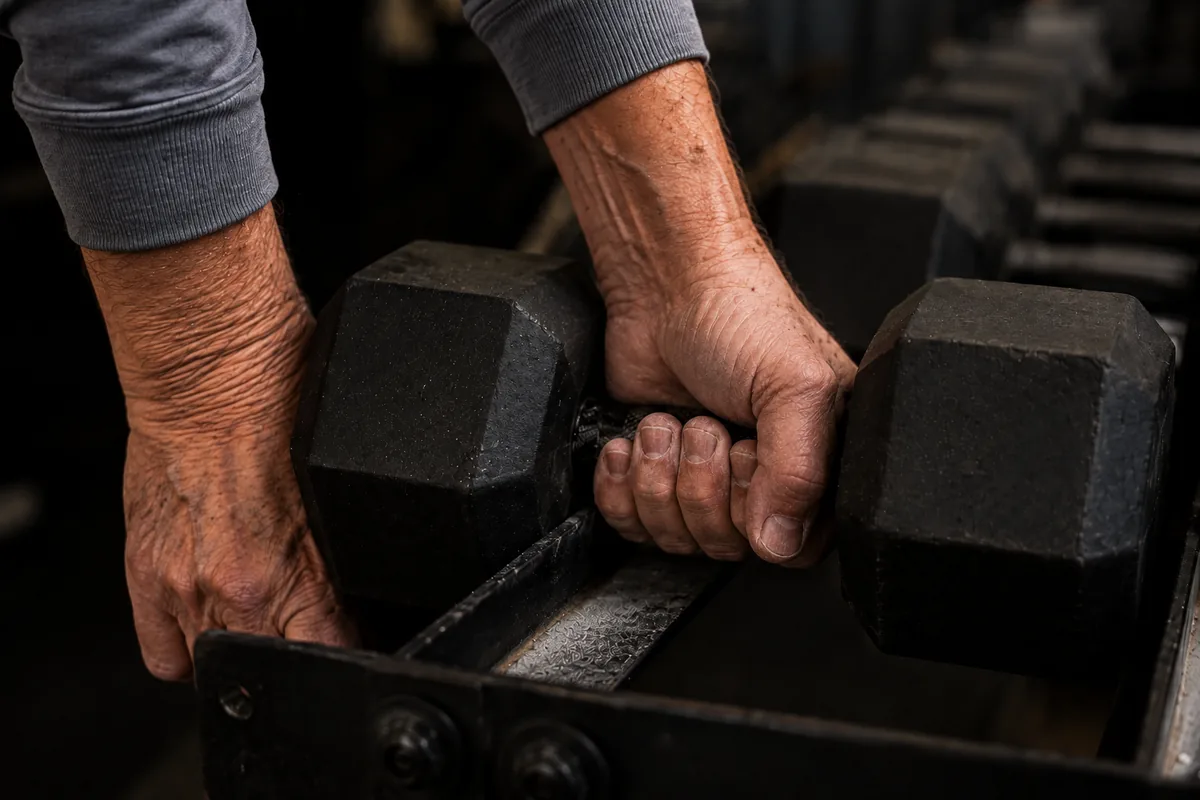
The third is the room itself. Alloy Personal Training in Edina runs groups of no more than six people, not forty. Nobody's filming. The music is at a volume where you can ask a question and be heard.
Food, briefly
Protein matters more than people think, and on a GLP-1 with a suppressed appetite it matters more still, because you're eating less overall and the protein is usually the first thing to get squeezed out.
That's as far as I'll go. No numbers, no targets, no macro splits on a blog post read by someone whose history with food I know nothing about. If you want a number, a registered dietitian or your prescriber will give you a real one based on you. That's worth the appointment.
What isn't our lane
Dosing, side effects, nausea, whether to titrate up, whether to stay on: all of that is medical, all of it belongs to your physician, and any trainer who volunteers an opinion on it should worry you.
Same goes for pain. If something is sharp, one-sided, and wakes you up at night, that's a physical therapist conversation before it's a training conversation, and we'll tell you so.
Back to the quiet voice
The people who tell me about the medication in a low voice usually stop doing that around week six or seven. Not because I said anything reassuring. Because by then there's a number on their sheet that went up, and the medication has stopped being the whole story of what's happening to their body.
I don't know how any given person's next two years go. Neither do you, and anyone selling certainty about it is selling something. What I do know is that the muscle you build while the medication is doing its work is yours afterward, and the muscle you don't build isn't sitting around waiting for you to get to it later.
Book a Starting Point Session. We'll talk through where you are, look at how you move, and figure out what two or three days a week actually looks like in your week.