
Perimenopause changes five things on your program card: heavier loads, counted sets, longer rest, planned protein, and monthly measurement. A study of 1,246 women found fat mass rising faster and lean mass slipping in the 3.5 years around the final period. A 2026 pooled analysis of 4,019 women found strength gains from resistance training were just as large after menopause as before it. Nothing about strength training for menopause calls for training softer.
- Perimenopause usually starts in the mid-to-late 40s and lasts about four years on average.
- Around the final period, fat gain sped up and lean mass slipped in a study of 1,246 women, but weight gain did not accelerate.
- Strength gains after menopause matched those before it in a 2026 analysis of 4,019 women, so the load goes up.
- A 2023 trial suggests women past menopause likely need more than 6 to 8 sets per muscle each week, not fewer.
- A bad-sleep week becomes a lighter week, not a skipped one, and a monthly InBody scan shows whether muscle is holding.
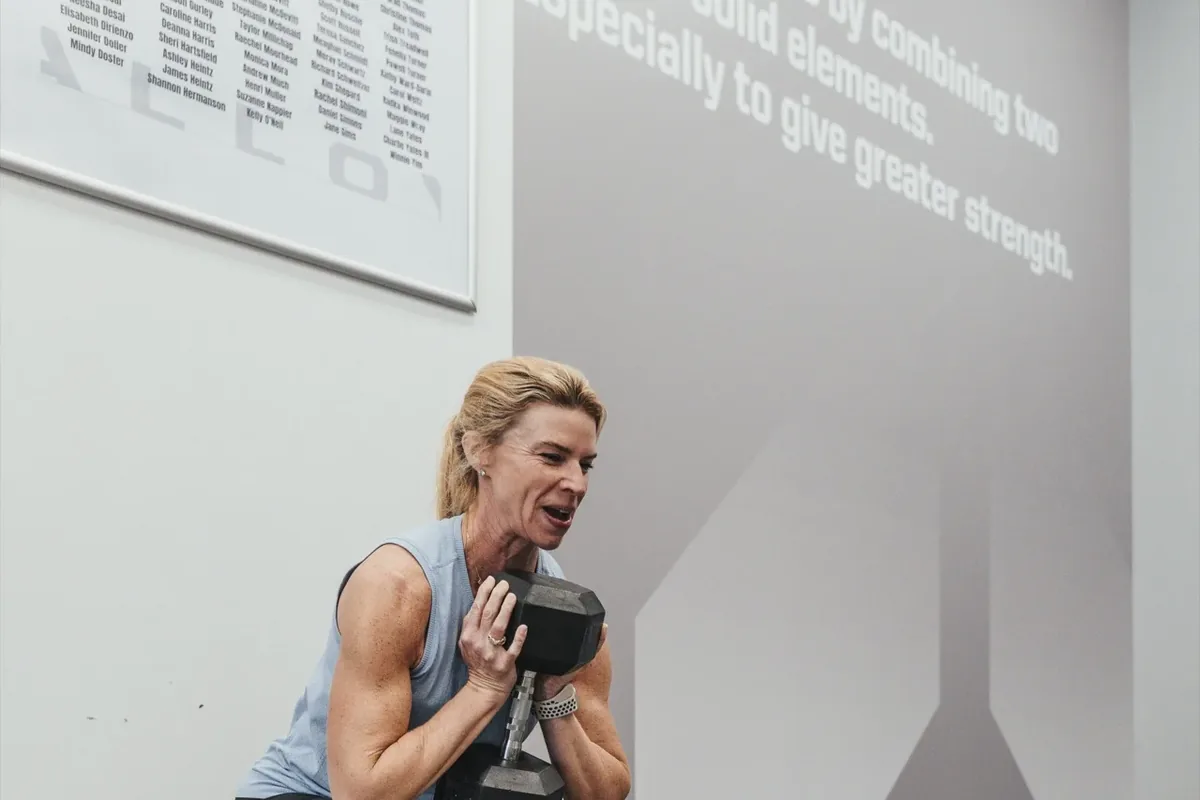
Perimenopause in calendar terms
Perimenopause is the stretch of years leading up to your final period, and it usually starts in your mid-to-late 40s. The HHS Office on Women's Health puts the average age of menopause in the United States at 52. It says women spend about four years in perimenopause on average.
Four years is the number to build a program around. At two sessions a week, that's more than 400 workouts. It's long enough to build real strength, and long enough to lose some if you coast.
We don't try to pin down your stage. That's your physician's call. What your coach watches is what shows up in the studio: your sleep, your lifts, and how you recover week to week.
What researchers measured during the transition
Researchers measured two shifts during the transition: more fat and slightly less lean mass, and spine density falling before periods stopped.
A 2019 analysis from the Study of Women's Health Across the Nation (SWAN) followed 1,246 women with DXA body scans from 1996 to 2013. In the 3.5 years around the final period, fat mass rose 1.7% a year, up from 1.0% before. Lean mass went from a 0.2% yearly gain to a 0.2% yearly loss.
Over that window, the women gained about 1.6 kg of fat on average, roughly 3.5 pounds, and lost about 0.2 kg of lean mass. Weight kept climbing at the same steady pace it had before, with no speed-up at the transition. After the transition, both the fat and lean trends leveled off.
The shift was in proportion, not on the scale.
Bone started changing before menopause itself. In a 2008 SWAN analysis of 1,902 women, spine density began falling about 1.6% a year in late perimenopause, before periods stopped. Hip density fell about 1.0% a year over the same stage.
These are group averages from large studies. They don't say what caused the changes, and they aren't a forecast for you.
Change 1: strength training for menopause goes heavier, not lighter
The first change is the weight you lift, and it goes up. A lot of perimenopause exercise advice still says light weights and high reps. The research on women around menopause points the other way.
A 2026 pooled analysis of 126 studies and 4,019 women looked at menopause and strength training directly. Strength gains from resistance training were just as large after menopause as before it. The women averaged about 51, and about two-thirds were postmenopausal.
Heavy lifting has also been tested with women further along. The 2018 LIFTMOR trial enrolled 101 postmenopausal women with low bone mass. The lifting group did sets of 5 at more than 85% of their max, twice a week for 8 months, in 30-minute supervised sessions.
Their lumbar spine density rose 2.9%, while a home group doing low-intensity exercise lost 1.2%. Compliance was 92%, and the trial recorded one adverse event, a minor low back spasm.
Those women averaged 65 and already had low bone mass. Read the result as evidence that heavy, supervised lifting was workable in that group, not as a bone promise for a woman of 48. Our page on strength training for women over 40 covers the cost of training too light.
Nobody starts at 85% of max. Your coach builds toward loads of about 70% of your max or more over several weeks, checking form on every set.
Change 2: count your sets, and expect to need more
Counting comes next. Your weekly sets per muscle get written down instead of guessed. The one free-weight trial of perimenopause strength training, in women averaging 52, suggests that number should rise.
In a 2023 trial, 31 women averaging 52 lifted free weights twice a week for 10 weeks. Each muscle got 6 to 8 sets a week. All groups got stronger on the squat and bench press, and no injuries occurred.
Muscle gain told a different story. Fat-free mass, muscle mass, and thigh muscle thickness rose only in the premenopausal women. The authors concluded that women past menopause likely need more than 6 to 8 sets per muscle each week.
That's the opposite of "do less as you get older." Sets go up, and each one has to be a real working set, heavy enough that the last couple of reps slow down.
Frequency rises with volume. Most Alloy members train two or three times a week, which spreads the extra sets across enough sessions to recover between them. Here's the full program card.
| Variable | The "be careful after 40" plan | What the research points to |
|---|---|---|
| Load | About 50% of your max | 70% of your max or more, built up with a coach |
| Reps per set | 15 to 20 | 5 to 8 on main lifts |
| Rest between sets | About 45 seconds | 2 to 3 minutes on main lifts |
| Weekly sets per muscle | Guessed | Counted, and likely more than 8 |
| Sessions per week | 1 | 2 to 3 |
| Tracking | None | A training log plus a monthly InBody scan |
Not every exercise lives at 5 reps. Accessory work still runs higher. The training log is what makes the rest of the table work, because "heavier" and "more sets" are guesses without it.
Change 3: rest longer and recover on purpose
Time is the third change. Rest between heavy sets gets longer, and recovery gets planned into the week instead of hoped for.
In a 2016 study of 21 trained young men, 3-minute rests beat 1-minute rests for squat and bench press strength over 8 weeks. Young men who already lift aren't women in perimenopause, so we treat this as a direction, not a rule.
In practice, main lifts get 2 to 3 minutes of rest. The goal is to lift the next set at the same weight, not to keep your heart rate up.
Sleep is the recovery variable to watch. In a 2008 study of 3,045 women aged 42 to 52, 30.8% reported at least one sleep difficulty at the start. The odds of waking several times a night were about twice as high in late perimenopause.
A bad-sleep week becomes a lighter week, not a skipped one. Your coach lowers the load and keeps the session on the calendar. If poor sleep drags on for weeks, bring it to your physician. The same goes for sharp pain, dizziness, or chest discomfort during a session.
Off days count too. Through a Minnesota winter, a coached indoor session is the part of the week that doesn't depend on the weather. Between sessions, a walk on the paved loops around the ponds at Centennial Lakes counts as recovery. So does an easy loop on the groomed ski trails on the golf course at Braemar Park.
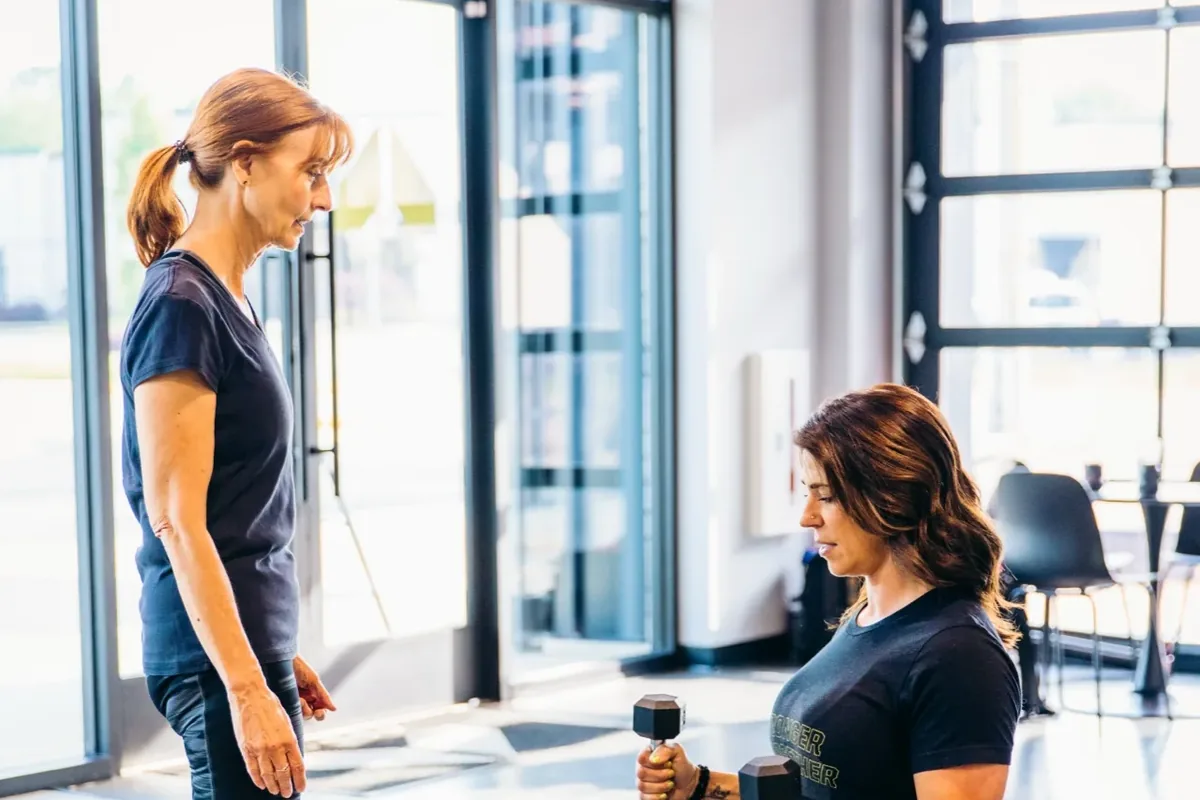
Change 4: plan protein and drop what works against you
The fourth change happens outside the session. Protein gets planned instead of left to chance, and a couple of common habits get dropped.
The published protein ranges weren't written for perimenopause, so it helps to know whose numbers they are. A 2013 expert group writing about adults over 65 suggested 1.0 to 1.2 grams per kilogram of body weight a day. It suggested at least 1.2 for those who exercise and made an exception for people with kidney disease.
The International Society of Sports Nutrition's 2017 position stand gives exercising adults a range of 1.4 to 2.0 grams per kilogram a day. It suggests 20 to 40 grams per meal, every 3 to 4 hours.
Neither range is a prescription for you. Our nutrition coaching is practical and evidence-based, with no fad diets. If you have kidney disease or another condition, your physician sets the target.
Now the stop list. Stop pairing strict dieting with extra cardio and no lifting. A 2017 trial put 160 adults over 65 with obesity on a weight-loss diet. Lean mass fell 5% with aerobic exercise alone and 2% with resistance training. Older population, same direction. Stop switching programs every few weeks, because progress needs the same lifts long enough to measure.
Hormone therapy and medication are decisions for you and your physician, and we're glad to coordinate with your doctor on the training side.
Change 5: measure muscle every month
The fifth change is feedback. You judge the program by body composition, not the bathroom scale.
An InBody scan measures skeletal muscle mass, body fat percentage, visceral fat level, total body water, and a segment-by-segment breakdown. It doesn't diagnose anything. It shows whether the work is moving the numbers you're training for.
Membership includes a scan every month, because a trend tells you more than any single reading. Body-composition change typically shows over 8 to 12 weeks, so give the first two or three scans time before you judge the plan.
If you want a baseline, book a free InBody scan, no membership required. Our guide on how to read your InBody results walks through the numbers that matter most.
Start with a Starting Point Session
Alloy Personal Training Edina Southdale opened in October 2026 on York Avenue, minutes from Southdale Center. Sessions are capped at six and coached for all 55 minutes, and the woman next to you may be doing entirely different work. The first visit is a no-pressure Starting Point Session: a movement assessment, your goals, an InBody scan, and a plan built around you. Book your Starting Point Session, and ask about Founding Membership if you'd like first pick of session times.
This article is general fitness information, not medical advice. Talk with your physician before starting a new exercise program, especially if you have a diagnosis, a recent surgery, or activity restrictions.
Frequently asked questions
Should I lift heavier or lighter in perimenopause?
Heavier, built up gradually with a coach. The 2026 pooled analysis of 4,019 women found no drop in the strength response after menopause. In the LIFTMOR trial, the lifting group, women averaging 65 with low bone mass, trained above 85% of their max twice a week. The trial recorded one minor adverse event in 8 months.
How many days a week should I strength train during menopause?
Two to three is a practical target. A 2023 trial of women averaging 52 and the LIFTMOR trial both used two sessions a week. All groups in the 2023 trial got stronger on the squat and bench press. A third day gives room for the higher set counts women past menopause likely need.
Does perimenopause cause muscle loss?
Studies have observed a small decline during the transition, though they don't show what caused it. In a study of 1,246 women, lean mass went from a 0.2% yearly gain to a 0.2% yearly loss around the final period. The total was about 0.2 kg over 3.5 years, and the trend leveled off after the transition.
Why is my sleep worse, and should I still train?
Yes, with the load adjusted. In a study of 3,045 women aged 42 to 52, the odds of waking several times a night were about twice as high in late perimenopause. On a bad-sleep week, lower the weight and keep the session. If sleep problems persist, talk with your physician.